City Of Dallas Can I Tint My Windshield
If you live in the City of Dallas and you want to know whether you can tint your windshield, Texas law is stricter on that one pane than on almost any other glass on a passenger car. A full aftermarket film job across the viewable area is generally not allowed. A non-reflective strip above the manufacturer’s AS-1 line is the usual legal option. Faith Low Price Auto Glass replaces cracked and chipped glass from the shop at 807 Fletcher St and on mobile jobs across Dallas–Fort Worth. They are not a window-tint shop, and this page is not legal advice — it is a plain-language read of the public rules so you do not mix up a shade band with a dark windshield.
What Texas law actually says about windshield tint
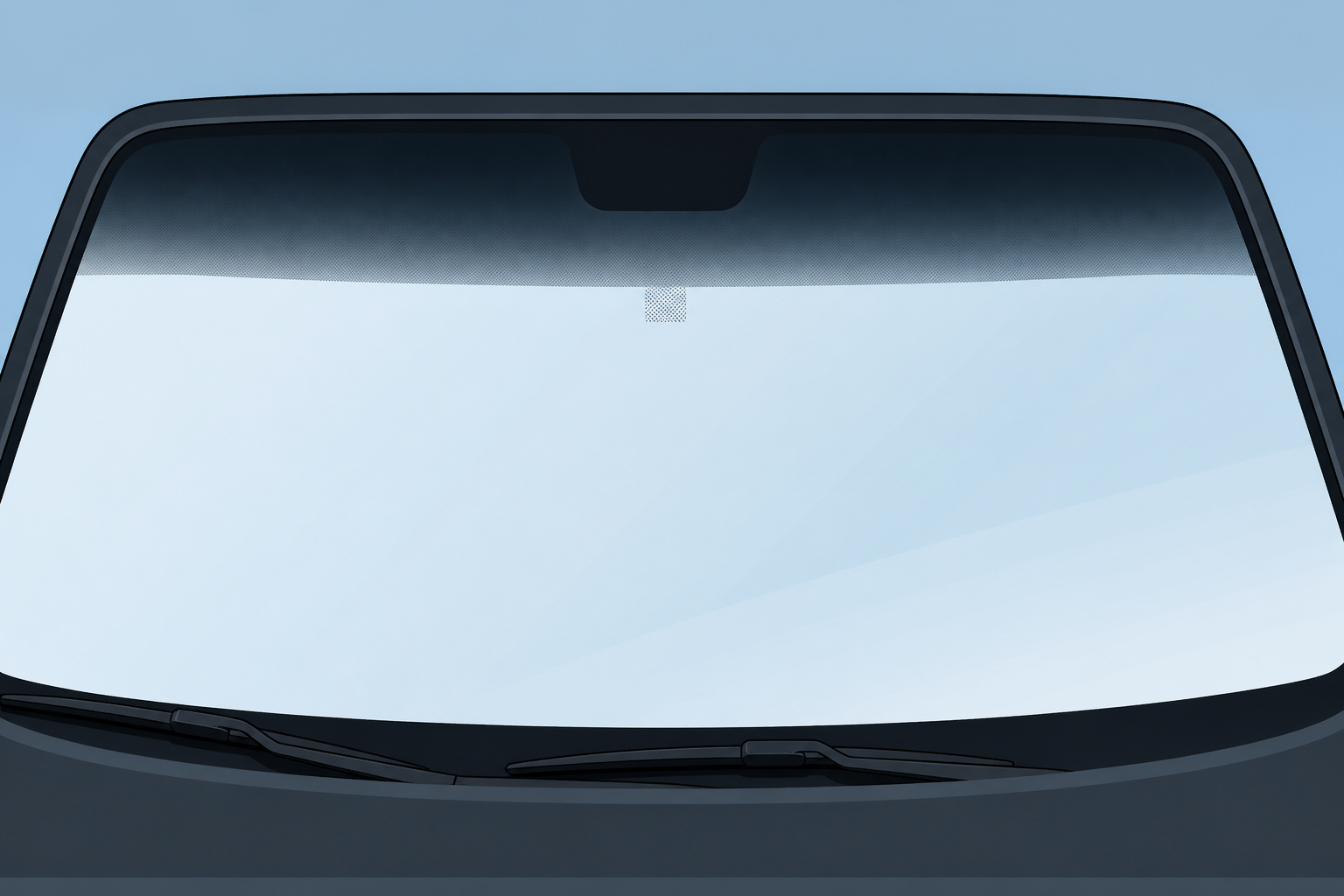
Texas Transportation Code rules on sun-screening devices treat the windshield as a safety view, not a privacy pane. In practice that means you generally cannot apply film below the AS-1 line — the small mark the glass maker etches near the top of the windshield. Anything that darkens the driver’s forward view under that line is the part that draws tickets. Dallas Police enforce that same statewide standard; there is not a separate city percentage for windshields.
People often hear a number like 25 percent and assume it applies to every window. That 25 percent visible-light-transmission (VLT) figure is for the front side windows, not the windshield. The windshield rule is positional: above the AS-1 line you may have a non-reflective strip; below it, the glass is supposed to stay clear.
The AS-1 line and the legal non-reflective strip
Look at the upper edge of your windshield from the driver’s seat. You will usually see a faded factory shade already in the glass, plus a small “AS-1” or similar marking a few inches down from the roof. That mark is the manufacturer’s line. A non-reflective tint strip that stays above it is the typical legal windshield treatment in Texas. Reflective or mirrored film, even in that strip, is a different problem and is not the safe assumption.
The factory shade band is not the same as aftermarket film. Many Dallas vehicles leave the plant with a light gradient baked into the laminate. That band does not give you permission to add a second, darker layer that drops into the wiper sweep. If you cannot find the AS-1 mark, do not guess by measuring from the visor. A glass shop can show you the etch; a tint installer who shrugs and films to the rearview mirror is guessing with your citation risk.
Front side windows, rear glass, and passenger cars
For a regular passenger car in Texas, the front side windows may not be darker than 25 percent VLT. That is a transmission floor, not a “how dark can I go” marketing number: 25 percent means 25 percent of light still gets through. Rear side glass and the backlite have no VLT limit for passenger cars, which is why you see dark rears and a much lighter front on the same SUV in East Dallas or Oak Cliff.
Those side and rear rules do not loosen the windshield rule. A legal 25 percent front door does not authorize a matching film on the windshield. If your vehicle is not a standard passenger car, confirm the class before anyone films anything.
Medical exemptions through Texas DPS
Texas Department of Public Safety does issue medical exemptions that can allow darker film than the default numbers. The process runs through DPS, not through the City of Dallas and not through an auto-glass shop. You typically need documentation from a qualifying medical provider and you carry the exemption in the vehicle. Mentioning that path exists is not the same as saying you qualify.
An exemption, when issued, is specific. It is not a blanket “tint whatever you want” card, and it does not erase other rules such as a non-reflective windshield strip or a cracked windshield that already fails a visual check. If you think you need an exemption, start with DPS — not with a film kit and a heat gun in a driveway off I-30.
How Dallas Police and DPS talk about tint in the real world
Enforcement is usually a traffic stop, a visual look, and sometimes a meter on the side glass. Windshield film below the AS-1 line is easy to see from the curb: the glass looks smoked through the steering wheel, especially at night on I-35, I-30, or LBJ 635. Officers do not need a complicated test to notice a fully filmed windshield. A ticket can include a fix-it period.
DPS troopers use the same statewide numbers. Driving from Dallas into Plano, Irving, Garland, or Arlington does not change the windshield rule. What changes is how obvious the film looks under different lighting. Summer glare on Central Expressway can hide a light strip and make a dark windshield look even darker. Do not treat “I have not been stopped yet” as a legal analysis.
A cracked windshield is a glass problem first
Tint questions collapse if the windshield is already starred, cracked, or chipped in the driver’s sight line. Texas inspection and everyday safety both care more about a clear, intact windshield than about a shade strip. Film over a crack does not stabilize laminated glass. It can hide the damage, trap moisture, and make a later replacement messier when the film has to come off with the old pane.
If the glass is damaged, deal with the glass. Faith Low Price Auto Glass can replace a windshield with OEM or aftermarket glass, automotive-grade urethane, and in-house ADAS camera recalibration when the vehicle needs it. Replacement for qualifying vehicles with standard glass is listed from $99; acoustic, heated, HUD, or ADAS-equipped glass can cost more. They help with insurance claims when your comprehensive coverage applies — coverage still depends on the policy, not on a shop promise of a zero deductible.
Faith Low Price Auto Glass replaces glass — they do not tint
The shop at 807 Fletcher St, Dallas, TX 75223 is an auto-glass shop. Call (214) 571-6266, book online any hour, or come in six days a week. Mobile service and same-day appointments run across Dallas, Plano, Irving, Garland, Mesquite, Richardson, Carrollton, Arlington, and the wider DFW metro. None of that is a tint-install service. If someone sold you illegal windshield film, replacing the glass returns you to clear factory glass. A new windshield does not come pre-filmed below the AS-1 line.
Use that reset. After the urethane is set and any camera work is done, you can decide — with a tint shop that actually follows Texas rules — whether a legal strip above AS-1 is even worth it. For service-area details see the Dallas–Fort Worth service area page, or contact Faith Low Price Auto Glass if the windshield is the part that needs to come out. Keep the legal question and the glass question separate.