Dallas Windshield Chip Repair
Not every mark on a Dallas windshield is the same animal. A round bullseye from a gravel truck on I-30 is a different repair than a star with legs, a combination break, or a half-moon sitting too close to the molding. People call all of them “chips,” then get frustrated when one takes resin and another needs a new pane. We are Faith Low Price Auto Glass. This page is about the shapes we actually see and which ones usually accept a proper fill.
The shop is at 807 Fletcher St, Dallas, TX 75223. We do mobile and in-shop work six days a week, and you can request a quote online any hour. Call (214) 571-6266 if you want us to look at a photo before you drive over.
Bullseye chips: the round pit that often takes resin
A bullseye looks like a small crater with a cone under the surface. It is the classic rock-chip shape. If it is roughly coin-to-quarter size, sits away from the edge, and has not opened into long cracks, it is one of the best candidates for professional windshield repair. Resin can fill that cone, lock the weak spot, and keep water out.
Bullseyes still fail the repair test when they are huge, dirty, or sitting in a camera cluster where optical distortion matters more than a faint witness mark. They also fail when someone has been digging at the pit with a key. We would rather see a fresh bullseye the afternoon it happened than a week-old hole full of car-wash soap.
Star breaks: short legs that like to walk in the heat
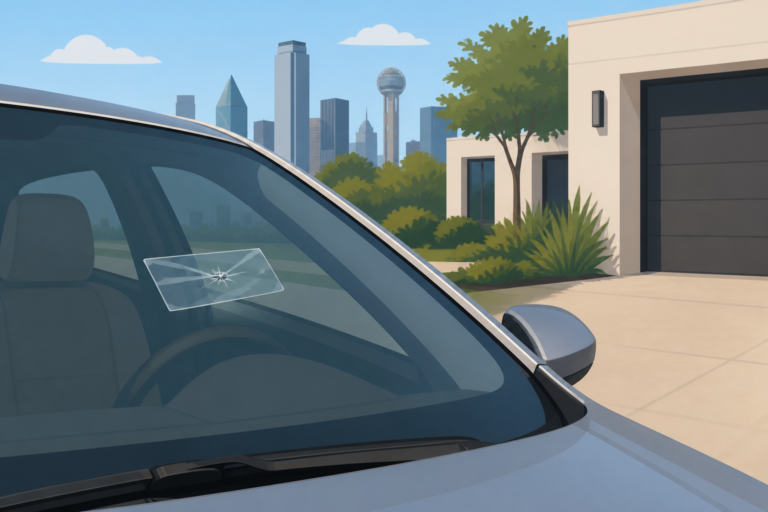
A star has a center impact and several hairline cracks radiating out. Those legs are easy to miss in shade and obvious at sunset on Central Expressway. Stars can take resin when the legs are short and the center is still a chip, not a long crack. The risk in Dallas is that a star is already under tension. One more heat cycle or a hard bump on a broken section of I-635 can send a leg toward the pillar.
If a star leg has already grown longer than we can stabilize, or if several legs have joined into a web across your view, we stop talking repair. That is how stars become replacement jobs. Tape over the center if you cannot get in today. Do not flex the glass by slamming doors, and do not park it in full sun any longer than you have to.
Combination breaks: bullseye plus cracks
A combination break is a bullseye with one or more cracks coming off it. These are common after a bigger rock or a hit that already had a small pit from last month. Combination damage is a judgment call. If the cracks are short, the center is still small, and the whole pattern is smaller than a dollar bill and off the edge, resin may still make sense. If the cracks have length, or if they point at the driver’s sight line in a way we cannot clear, we will say so.
This is the shape people most often try to “watch for a few days.” In this climate that is how a combination break becomes a long crack. We would rather inspect it the same week.
Half-moon chips and other edge-adjacent hits
A half-moon, or partial cone, often shows up near the edge or after a glancing hit. Edge-adjacent glass is already the most stressed part of the windshield. Body flex at the A-pillar, a slightly twisted frame, even a door slam can open an edge chip into a run that follows the molding. Those runs are the ones that usually need a full windshield replacement.
If the half-moon is truly in the field of the glass — not hugging the black band — and it is still small, we may still fill it. If it is kissing the edge, do not count on resin. Bring it in and let us be the ones to say no. A shop that promises every half-moon can be saved is selling hope, not glass work.
Which of these usually take resin — and which do not
A short, honest map:
- Small, clean bullseyes away from the edge: often yes.
- Stars with short legs and a tight center: often yes, if we catch them early.
- Combination breaks: maybe, if the whole pattern is still small and stable.
- Half-moons near the edge: often no.
- Long cracks, edge cracks, cracks through the driver’s view we cannot clear, multiple spreading cracks, shattered glass, or damage into the PVB interlayer: replacement.
Location matters as much as shape. A perfect bullseye in a dense camera or HUD zone may still be a poor repair if we cannot restore a clean optical path. We do not invent a rule that every camera-zone chip must be replaced, and we do not invent the opposite. We look.
What we look at besides the shape
Shape is the start of the conversation, not the whole file. We also check dirt and moisture in the cavity, whether the inner lite is involved, how close the break sits to the edge, and whether the car’s ADAS camera sits behind that patch of glass. On a replacement we may need to talk about calibration. We will not invent a calibration price in a blog post.
Same-day inspections are often available. Mobile visits work when the site is clean enough to keep the break dry. If your driveway is a dust storm off a construction cut in East Dallas, come to Fletcher Street. Send a daylight photo through our contact page if you want a first pass before you leave the house.
Faith Low Price Auto Glass will not pretend a star is a bullseye to make the quote easier. Name the shape, or just show us the glass. We will tell you whether resin still has a job to do.